 Just published
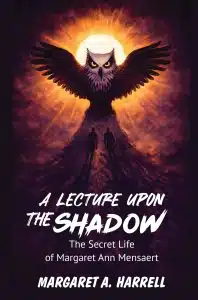
Click here to see on Amazon:
A LECTURE UPON THE SHADOW rips the fairytale of marriage apart and burns it entire on a Moroccan blue bone fire. A journey through hell. Beyond Goethe, beyond the French existentialists, through and beyond Jungian depth psychology, beyond the novel, beyond autobiography, beyond creative non-fiction, A LECTURE UPON THE SHADOW is a completely new eloquently painful way of telling a self-actualization story. Margaret Ann Harrell has rendered an excruciating masterpiece. It’s brilliant. And there’s no other book like this one, anywhere, ever.
—Ron Whitehead, US Lifetime National Beat Poet Laureate
“Love is a growing, or full constant light; And his first minute, after noon, is night.”
– John Donne, from his poem “A Lecture Upon the Shadow”
Book Description.
It was 1983. I was at the C. G. Jung Institute, Zurich. The famed Jungian Marion Woodman was speaking:
“Ted Hughes and Sylvia Plath—they were examples of the anima female,” she was telling us engrossed listeners. “Marilyn Monroe too,” she continued.
What?! Listening to her, I knew:
A Lecture upon the Shadow is about the anima female! It’s about couples just like that, but from the inside.
She read the manuscript, very moved, confirming it was written unconsciously. I had no knowledge of the term or concept. I might have to wait ten years for everybody to understand it, she predicted. That’s more than FORTY years ago! Will people understand it now? Be helped? Are there any other “anima females” out there, acting as muses?
This book knocked the Bukowski I was reading straight out of my hands. It pulled me. Dragged me. Brought me in. I followed without hesitation. I laughed loud, then caught that cold little echo in the spine because I know that voice. We all know that voice.
Younger readers are going to feel this one like a mirror of recognition. The book never retreats. It kicks forward, barefoot, through broken glass, still cracking jokes. It is funny in the only way that counts. Not decoration. Not relief. The laugh hits first; then the truth lands just behind it, sharp enough to leave a mark. Some pages tickle. Some bite. You finish the book feeling seen, steadied, and slightly more dangerous than when you began.
—Daniel O’ Bailey, Gen-Z musician & Author
What if Alice had fallen in love with the Hatter?
What if Wendy had been Peter’s child bride?
What if the fairy tales were true, but the endings were shuffled like a deck of mismatched cards?
—Chris Dean, Indiana Beat Poet Laureate on beginning A Lecture upon the Shadow
A LECTURE UPON THE SHADOW is about finding yourself inside someone else’s interior castle. It describes animal movements over stone as one foot faithfully follows the other OUT. It is for anyone with the teeth to embrace the soft horror of love. Margaret Ann Harrell’s writing exists in the liquid, violet place just below reason. With spiritual authority, it arrests your analytic mind and pockets romantic delusion. It is memory with a beating heart. It is very true.
The real beauty of SHADOW is the quality of aliveness it carries. It has no pretense or analysis and is written exactly how these things are experienced (experienced here in the supra-chronological sense that melds past with present with perennial wisdom). It is like watching a slice of cake be digested in a barometric Buddha chamber. It makes no sense until it does.
The meat of the book exists almost entirely outside of physical reality and feels tethered to bone only by habit. It could be downloaded to your consciousness without the structure of language. That’s a very rare thing, and I’ve not seen words work quite like that before.
I can see why the author loved this man and his command of language and let herself be pulled into his tapestry of consciousness. The image I get when writing this is of a large, velvet loom. Deep blues and purples and an occasional violent orange. Like the sprinkles on a cosmic brownie (Lil Debbie). How sweet. I could make an allusion to cosmic brownies also being considered poison in some countries.
Yes, karmic bonds. We love to go deeper, together. Which is why we can only love people who match our depth. I just wish he hadn’t thought so much of himself. The author is a kerosene lantern in a dark wood. Of course, we readers all fly to her. This needs to be read. She is a master.
—Emma Louise Rodgers, PhD, Psychological Science, Associate Professor